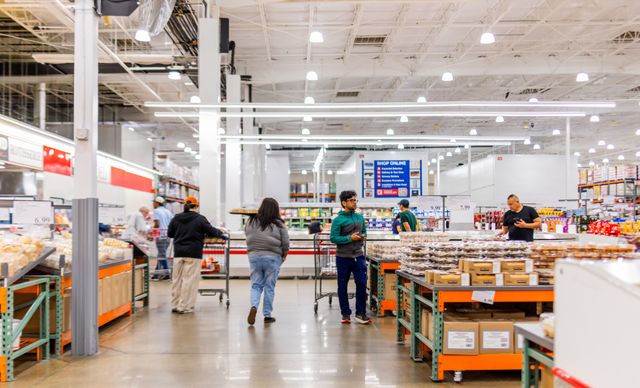
WASHINGTON, November 13, 2026 – Imagine Saturday mornings in any suburban parking lot. Two carts, but two very distinct shopping experiences. One consumer is stopping by for some milk, bananas, and a roasting chicken on the way home from soccer practice. Another is pulling into the store with a flatbed loaded down with cases of paper towels, gallons of olive oil, and tons of frozen salmon.
They are both shopping for groceries, but only one of them, increasingly, is shopping for groceries at a warehouse club.
That subtle change just revealed itself in the numbers. In terms of spending share, Costco has surpassed its Cincinnati-based rival for the No. 2 spot among grocery retailers with 8.4% of the food and beverage spend, compared with 8.2%. Those numbers are drawn from Numerator’s most recent retailer tracker, which covers the period through September 30, 2026.
It comes down to two-tenths of a point. Don’t be misled.
Why a sliver of a percentage point matters
When dealing with extremely tight margins, every percentage of total grocery spend in the country means serious money. And not just the gap, but its trajectory is very important indeed.
Two years ago, the gap was much wider, as Costco’s share was 7.7% against 8.7% for the traditional supermarket chain. Just one year later, the first company managed to grow slightly, up to 7.9%, whereas the second one fell to 8.4%. While one of the lines rose and another one fell, the cross-over happened.
A five-year grind
But Costco’s rise isn’t a new thing for 2026. According to Grocery Dive’s analysis based on five years of Numerator data, Costco’s share has increased from 7% in 2020-2021 to 8.4% in 2024-2025 and has been the only player out of the top 20 retailers increasing its share every year.
Every year. In the sector in which most of the market participants swap small increases and decreases, such a regularity is rare and quite dull in its predictability. Boring wins, it seems.
On the flip side of this medal, the situation is a bit uglier. According to the same analysis, the shares of the supermarket chain were decreasing every 12 months and reached 8.5% after having been 9.8%. The traditional grocers are struggling to keep up with relevance among consumers who spend money in different locations.
So why are people doing this?
Price is the most obvious reason, and the one that works. Consumer Reports, through its own research agency, Strategic Resource Group, conducted an analysis of shopping baskets of common goods among several store chains. Comparing the price of a big-box discounter chain as a baseline, Costco offered goods at 21.4% lower cost, while the regular supermarket chain offered 14.8% higher prices. This is a comparison of baskets rather than single items, but with each visit you’ll see your basket costs more and more.
The membership model is the next factor, making your visits to the store a sort of obligation, as once you have paid for membership for the year, you want to use it to your advantage.
Is the story that simple? Most likely, no. Costco doesn’t have a wide selection compared to a traditional supermarket. There will be no last-minute shopping for a missing component at the warehouse club, while some families still visit the traditional grocery store every week. It has just shifted the major purchasing process to another location.
This is where the problem lies. Numerator monitors the money being spent by shoppers, but not the number of switching shoppers and does not mention anything about profits. Where the additional amount of money spent at Costco came from is difficult to tell from the information provided. No one knows how much of it was spent by the traditional supermarket shoppers and how much by other households.
The response
The supermarket industry won’t just sit there and do nothing. The move was made in light of the company announcing plans to pump $5 billion into price cuts to reclaim its competitiveness. This seems to be a considerable amount, and it shows that the company is seeing the same numbers that others are.
It remains uncertain whether money can solve the problem at all. Competing with a warehouse club on prices on the whole basket is rather costly and may not be a good strategy at all. Analysts claim that the better strategy would be to protect those fast and regular visits where a community store is more advantageous. In my opinion, it is hard to say what the outcome will be.
Not just a two-horse race
Looking at the bigger picture, there’s more competition. In the wider universe of consumer packaged goods, including those outside food such as housecare and pet supplies, Amazon’s online platform plus Whole Foods and in-store grocery diver, 8.1% of total spending, lagging Costco by 0.1 points behind its 8.2%. The study observed that total spending was increasingly dominated by major players, with conventional groceries lagging.
At the same time, not much changes on the grocery spending chart. At the top, the largest grocery retailer accounts for 20.3% of total spending, more than twice that of anyone following. To put it simply, the second spot is like a fight for a very distant silver medal, but it is the fight that defines the future.
Back to the parking lot
Return to the two carts. The shopper who made a fast visit and the shopper with the flatbed could be the same individual, but from a different week. That’s the beauty of the achievement; it is not the story of one firm winning over the other. It is a tale of quiet shifts in the habits of households to feed themselves, one membership card at a time.
Costco didn’t force its way into the No. 2 spot by loud claims. It simply came in each and every quarter that its competitors chose to look away. Whatever happens in the following twelve months—whether it is a fightback or more of the same—it will be a new player in the No. 2 position.