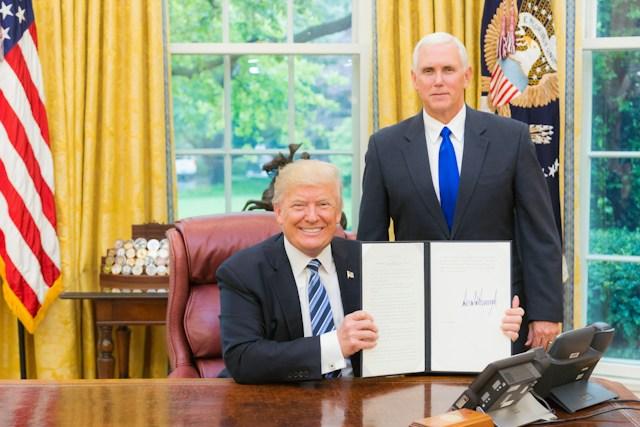
WASHINGTON, September 16, 2026 – President Donald Trump has refused to support any form of additional regulation of the field of artificial intelligence, saying that there’s sufficient criminal and regulatory power in the US to control this sector.
President Trump also attacked the CEO of Anthropic, Dario Amodei, in his social media posts on Monday after the latter called on his company and other firms in the industry to pause work on developing more powerful and capable technology because of lagging safety controls. President Trump was making an attempt to show how this could affect the technology industry in America against its rival, China.
In his posts, Trump said that “The only control or ‘guardrails’ that AI needs is a STRONG AND SMART (High IQ!) PRESIDENT”.
The conflict underscores an increasing divergence between tech leaders in Silicon Valley. There are some who believe that fast progress with respect to frontier technologies might create dangers related to fraud, cybersecurity, autonomy of decision-making, and public safety concerns. They wish for organizations to take more time to test their algorithms thoroughly.
For Trump and his team, the issue isn’t quite the same. For them, the message is clear: if America delays in its actions, it may lose the technological and economic edge over China. And data centers that need massive energy inputs have become the focal point of that struggle and local resistance.
It becomes a politically uncomfortable situation because, on one hand, Washington seeks to speed up investments in AI technologies, and, on the other hand, communities which receive data centers, need to know who will pay for substations, upgrading of transmission lines and generating stations that will power them. The discussion isn’t limited to scientific laboratories and startup offices anymore, as it has found its way into planning boards, utility commissions and residential areas.
The question regarding adequacy of the current legislation is still open. US federal agencies regulate consumer protection, privacy issues, civil rights, cybersecurity and antitrust, but AI systems are evolving faster than laws regulating their development. In particular, NIST focused on testing, measuring, reliability, security and voluntary standards rather than on a single all-encompassing law on AI. The very nature of such regulation requires understanding of a system’s performance and reproducibility of its faults.
The criticism is that voluntary guidelines may not suffice for robust models used on a national level. The defense of mandatory requirements is that they would reinforce existing big firms, hamper innovation and investments in the US and elsewhere. Both arguments are legitimate. Neither solves the key question of responsibility if the automated system causes damage.
Thus, Amodei’s warning came during the period of a politically charged atmosphere ready for conflict. Trump’s answer implies that the White House cares more about speed and investment than setting any guidelines at this moment.
It would meet the satisfaction of companies eager to construct. However, it would not solve the debate. AI technologies are developing rapidly. Public trust, on the contrary, is difficult to gain.