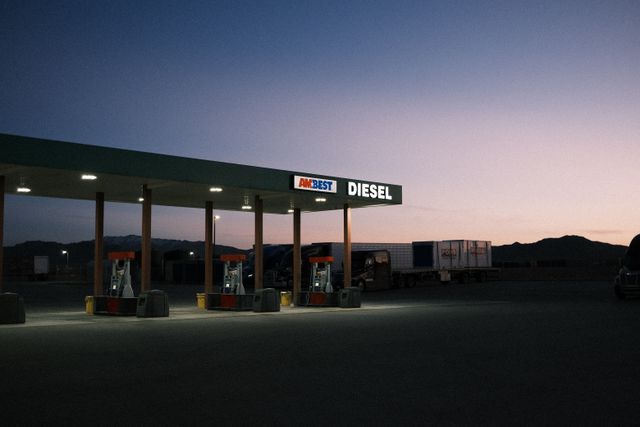
WASHINGTON, October 27, 2026 – Gas prices are still above $4 a gallon. Diesel has climbed past $6. And now the White House is reaching for a Cold War-era law to try to shore up the machinery behind American fuel supply.
On October 22, President Donald Trump made a presidential determination under Section 303 of the Defense Production Act of 1950 in relation to domestic capabilities for petroleum production, refining, and distribution. According to the memo, “the domestic capabilities for petroleum production, refining, and distribution… are essential to the national defense” and thus “may be acquired by purchase or purchase commitment, financial assistance, and such other means.”
This is the most recent exercise of the national energy emergency proclaimed by President Trump on January 20, 2025, via Executive Order 14156. In that order, inadequate energy production, transportation, refining, and generation were stated as a threat to the economy, national security, and foreign policy.
Why the White House says it must act
The administration’s rationale is simple: in the absence of presidential action, industry will not be able to provide the necessary capacity fast enough. The memorandum points out the limited financing, lengthy lead times, permitting, and supply chain issues as factors that make it impossible for the private sector to address the issue.
Trump also suspended certain procedural provisions of Section 303 of the Defense Production Act to increase capacity for petroleum-related activities. The determination requires the Secretary of War to carry out the order and publish it in the Federal Register.
Essentially, the White House is looking at refineries, pipelines, and fuel storage facilities as defense assets rather than just commercial facilities. As stated in the memo, petroleum powers the armed forces, the industrial base, and critical infrastructure; without immediate government action, U.S. defense capabilities “will remain vulnerable to disruption.”
The catch: refining is the hard part
Here’s the complication. U.S. already extracts oil and gas at near-record volumes, as mentioned by Grist, and the immediate concern among consumers pertains not to raw oil but to finished products like gasoline and diesel.
According to Grist, while gasoline has crossed the $4 mark per gallon, diesel prices are hitting a record high beyond $6, and “the crack spread”, or the difference between refined products and crude oil prices, is nearing a multi-year high in recent times, as the outlet explains that the current lack of refined fuels is caused mostly by war in Iran, where the Strait of Hormuz has been closed down and where refineries and oil fields have been destroyed.
That is because drilling new wells and building new pipelines does not necessarily mean more gasoline. In this case, it is refineries that become the limiting factor. As quoted by Grist from Abhi Rajendran, head of research at Energy Intelligence, American refiners are running “close to flat out.”
Construction of new refineries is costly and time-consuming. Grist explains that constructing large refineries is very costly, yet demand for processed fuel has dropped due to increased efficiency and rising popularity of electric cars.
Legal and political friction
This declaration comes at a time when there is increased opposition. At least a dozen states are suing against President Trump’s original energy emergency declaration, claiming that there is no real emergency situation. Oral arguments were set to take place on October 20.
There have been cases in which the claims of the administration have been tested by the courts. In September, an appeals court stopped the Energy Department from ordering Michigan’s J.H. Campbell coal plant to stay operational beyond its intended closure date. The court rejected the administration’s interpretation of the law, saying that the claim made by Energy Secretary Chris Wright of emergency was unpersuasive.
Melissa Birchard, the mitigation program director at the Climate Center at Georgetown Law School, told Grist that the increasing number of emergency declarations poses a legal question about whether there will come a time when courts won’t believe these emergencies anymore.
What it means for consumers
For motorists, long-haul truckers, and electric utilities, however, the significance of the announcement is likely less immediate than the Biden Administration envisions. According to reporting, the impact of executive action on fossil fuel production has only expedited select projects but hasn’t driven down the cost of gas or electricity; larger projects are still far from going online.
The White House memo, in turn, lacks specifics regarding projects, funding, or even a time frame; it instructs the Secretary of War to make “necessary purchases, commitments, and financial instruments.”
Herein lies the issue: Can Washington utilize its emergency powers? That is a certainty. The real question is whether Washington’s emergency powers can ramp up refining and logistical capabilities enough to help prices in the run-up to the election—and whether Washington’s premise for the use of these powers will gain legal, political, and market acceptance.