WASHINGTON D.C., July 1, 2026 — President Donald Trump’s proposal to construct a massive arch near Arlington National Cemetery has secured preliminary approval from the National Capital Planning Commission (NCPC).
In a decisive 8-1 vote, the commission approved the preliminary site and building plans for the 250-foot monument, which is intended to commemorate the 250th anniversary of American independence. The decision marks a major victory for the administration, allowing the project to advance despite fierce objections from veterans, preservationists, and urban planners who argue the structure would disrupt historic sight lines and violate federal laws.
A Great Monument
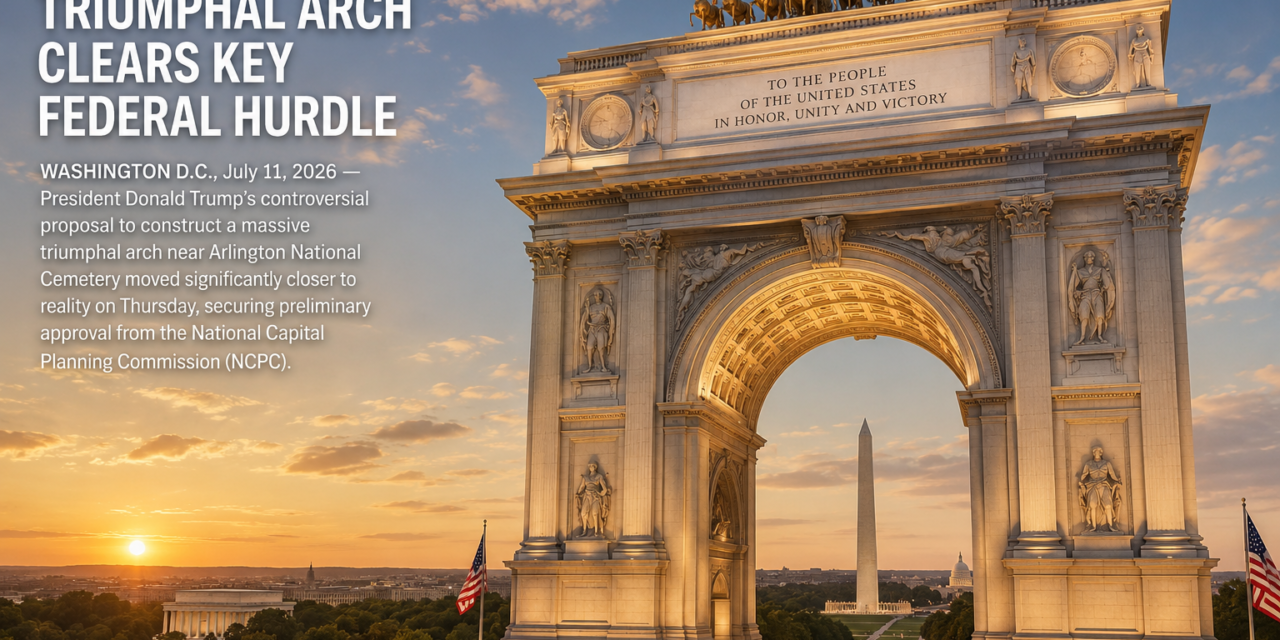
The proposed ‘United States Triumphal Arch’ would stand on Memorial Circle at the Virginia end of the Arlington Memorial Bridge, directly across the Potomac River from the Lincoln Memorial. The design features a limestone structure topped by a colossal bronze statue of a winged female figure, variously described as Victory or Lady Liberty, flanked by two eagles.
At 250 feet, the arch would be more than double the height of the nearby 99-foot Lincoln Memorial and nearly half the height of the Washington Monument.
NCPC Chairman Will Scharf, a Trump appointee who also serves as White House staff secretary, hailed the project as a fitting commemoration to the nation’s history. “I think commemorating America’s 250th anniversary is important,” Scharf stated following the vote.
However, the approval process was not without friction. Commission staff had recommended the panel request design changes to comply with the Height of Buildings Act of 1910, which generally limits structures in the capital to 130 feet to preserve the skyline. The administration has argued that federal monuments are exempt from this law or, alternatively, that the statue atop the arch constitutes a penthouse structure that exploits a legal loophole.
Rather than enforcing the height limit immediately, the commission voted to table the legal question until its next meeting in September, effectively allowing the project to proceed with its current dimensions for now.
Alarms Raised
The hearing was marked by emotional testimony from opponents, particularly regarding the arch’s location. Critics argue the massive structure would physically block the symbolic sight line between the Lincoln Memorial and Arlington National Cemetery – a vista designed to represent the reunification of the North and South after the Civil War.
Veterans expressed deep concern that the project would desecrate the solemnity of the cemetery. “We ask our dead for everything. The least we owe them is silence,” said Linsay Burnett, an Iraq War veteran, referencing plans for 20-hour workdays to complete the project before the end of Trump’s term. The accelerated construction schedule has raised fears that funerals would be conducted against a backdrop of pile drivers and heavy machinery.
Evan Cash, the representative for D.C. Council Chairman Phil Mendelson and the lone dissenting vote, warned that the approval sets a dangerous precedent. “Our skyline didn’t happen by accident,” Cash said, questioning whether any president should have the power to unilaterally alter the capital’s character.
Funding and Timeline
While the project has cleared this hurdle, significant questions about funding remain. President Trump previously claimed the arch would be funded by private donations or unused funds raised for a separate White House ballroom project. However, recent reports indicate that public money is being utilised for both the ballroom and the arch, though the White House has yet to release a definitive cost estimate.
The project still faces a final vote by the NCPC in September. If approved, construction would reportedly proceed at a rapid pace, potentially running 24 hours a day, to meet the President’s deadline of finishing before he leaves office.